Salome Chekurishvili

Every customer conversation has the potential to teach your business something valuable.
It might reveal why customers are canceling their subscriptions, highlight a product issue that keeps coming up, or show how one of your agents consistently delivers exceptional service. These conversations contain insights that can improve customer satisfaction, strengthen agent performance, and support better business decisions.
The challenge isn't collecting customer calls it's reviewing them.
For decades, manual call monitoring has been the standard approach to quality assurance. Supervisors would listen to recorded conversations, evaluate agent performance, complete scorecards, and provide coaching based on what they heard.
This process worked well when contact centers handled relatively small call volumes.
Today's contact centers are very different.
A growing business may process thousands of customer conversations every week across sales, support, billing, and technical service teams. Reviewing each interaction manually is no longer practical.
As customer expectations continue to rise, businesses need faster and more scalable ways to understand what happens during every conversation.
That's where artificial intelligence is making a significant impact.
At RoboNote, we help organizations move beyond manual call monitoring by using AI to analyze every customer interaction automatically. Instead of reviewing only a small sample of calls, managers gain insights from every conversation, enabling better coaching, stronger compliance, and more informed decision-making.
Manual call monitoring is the process of listening to recorded or live customer conversations to evaluate agent performance and ensure quality standards are being followed.
Quality assurance teams typically review conversations based on a scorecard that includes criteria such as:
● Professional greetings
● Communication skills
● Customer verification
● Compliance requirements
● Problem resolution
● Product knowledge
● Call handling techniques
● Closing the conversation appropriately
Managers document their observations and later share feedback with agents during coaching sessions.
While this process can provide valuable insights, it depends entirely on human effort.
Every additional customer conversation requires additional review time.
For many years, manual monitoring was enough.
Contact centers handled fewer calls, customer expectations were different, and businesses had more time to review interactions individually.
Supervisors could listen to a reasonable number of conversations each week and still provide meaningful coaching.
Because call volumes were manageable, reviewing a sample of interactions often provided a fairly accurate picture of overall performance.
However, the way businesses communicate with customers has changed dramatically.
Organizations now handle significantly higher call volumes while customers expect faster service, personalized experiences, and consistent support across every interaction.
The traditional approach simply hasn't evolved at the same pace.
Imagine a contact center with 100 agents.
If each agent handles just 30 calls a day, that's 3,000 customer conversations every single day.
Now imagine trying to review every one of those calls manually.
Even if the average conversation lasts only 10 minutes, quality assurance teams would need hundreds of hours just to listen to the recordings.
That's before they complete scorecards, write feedback, and schedule coaching sessions.
The numbers simply don't work.
As a result, most organizations review only a small percentage of calls.
While this approach helps reduce workload, it creates another problem: incomplete visibility.
Many contact centers evaluate only 2–5% of customer interactions.
Although this has been common practice for years, it raises an important question:
What about the other 95% of conversations?
Within those unreviewed calls could be:
● Customers experiencing the same recurring issue
● Compliance violations
● Missed sales opportunities
● Excellent examples of customer service
● Coaching opportunities for new agents
● Product feedback from customers
● Trends that could influence business decisions
When only a small sample is reviewed, managers make decisions based on limited information.
Important patterns often remain hidden simply because no one had time to listen to every conversation.
Listening to a call requires time.
Evaluating it requires even more.
A supervisor reviewing a 15-minute conversation may spend additional time:
● Replaying important sections
● Completing evaluation forms
● Writing coaching notes
● Comparing performance against company standards
● Preparing feedback for the agent
One call can easily take 20 to 30 minutes to review thoroughly.
Multiply that across hundreds of conversations each week, and it's clear why quality assurance teams often struggle to keep up.
Instead of focusing on coaching and improving performance, much of their day is spent performing repetitive administrative work.
Timing matters.
Imagine an agent makes the same mistake during customer calls all week.
If those conversations aren't reviewed until Friday or even the following week that mistake may have been repeated dozens of times.
Delayed feedback reduces the effectiveness of coaching because agents may no longer remember the conversation.
It also means customers continue experiencing the same problem until someone finally identifies it.
The faster managers receive insights, the faster they can help agents improve.
Even experienced quality assurance specialists may evaluate conversations differently.
One reviewer might focus heavily on empathy, while another gives more weight to call handling efficiency.
Fatigue, workload, and personal interpretation can also influence scoring.
This inconsistency can create confusion for agents who receive different feedback depending on who reviewed their calls.
A fair quality assurance process should apply the same standards to every conversation.
Maintaining that level of consistency manually becomes increasingly difficult as teams grow.
Compliance is another area where manual monitoring has limitations.
If managers review only a small percentage of calls, they may never hear conversations where agents:
● Skip customer verification
● Miss required disclosures
● Mishandle sensitive information
● Fail to follow internal procedures
Unfortunately, compliance issues don't only occur in sampled calls.
They can happen in any interaction.
Without broader visibility, businesses may discover compliance problems only after customer complaints or regulatory audits.
Artificial intelligence is changing the way contact centers approach quality assurance.
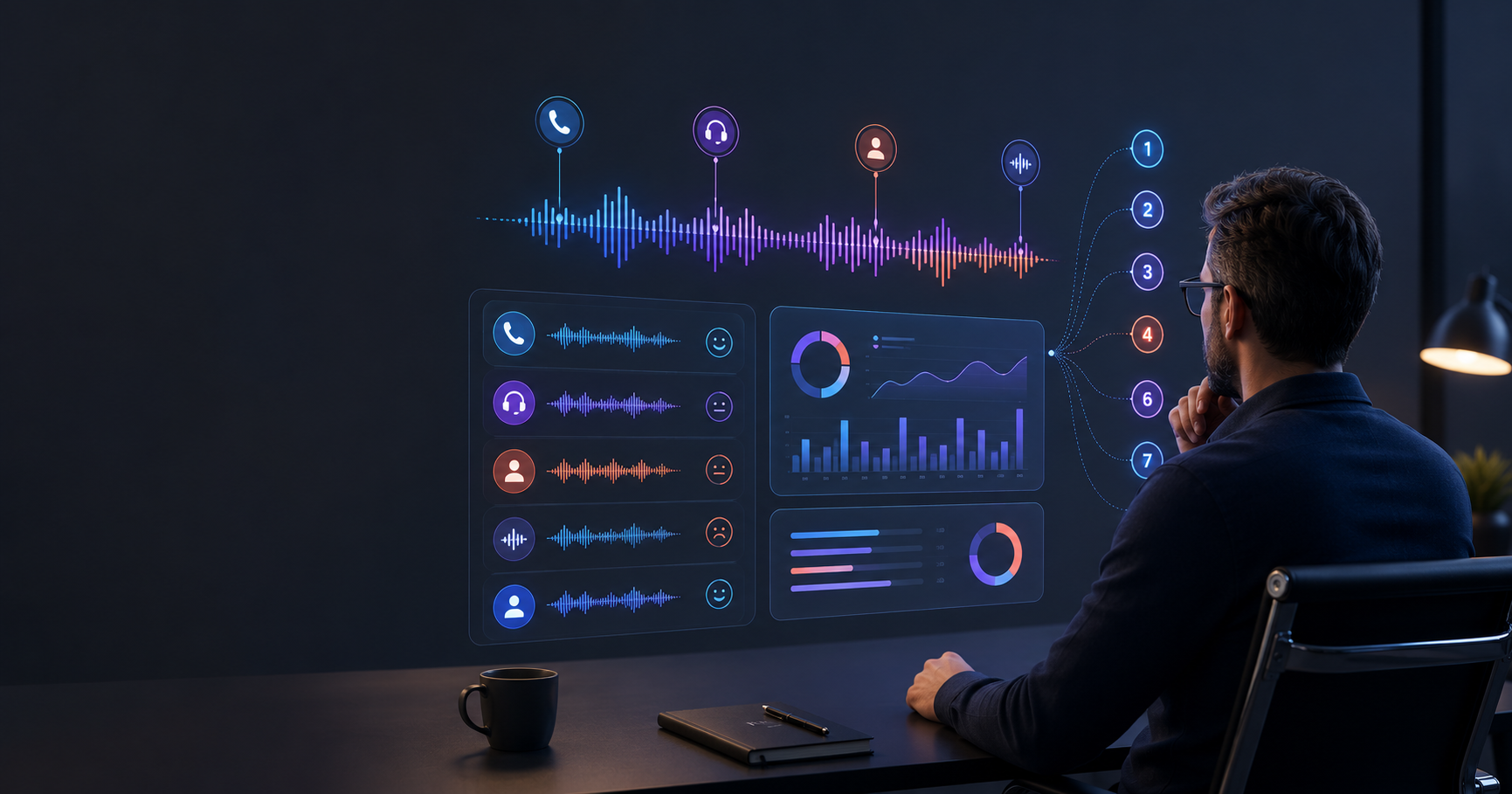
Instead of relying on managers to review conversations one by one, AI can automatically analyze every customer interaction. It listens to conversations, converts speech into text, identifies important topics, measures customer sentiment, and highlights conversations that need attention. It also evaluates each agent's behavior and performance.
Rather than replacing quality assurance teams, AI gives them the information they need to work more efficiently.
Instead of spending hours searching for problems, managers can focus on solving them.
One of the biggest advantages of AI-powered call monitoring is complete visibility.
Traditional quality assurance often relies on reviewing only a small percentage of calls because manual reviews require significant time and effort.
AI removes that limitation.
Every conversation can be analyzed using the same evaluation criteria, giving managers a more accurate understanding of customer interactions across the entire organization.
This broader view helps businesses identify:
● Recurring customer complaints
● Frequently asked questions
● Product or service issues
● Agent coaching opportunities
● Compliance risks
● Positive customer experiences
● Emerging trends before they become larger problems
Instead of making decisions based on a small sample, managers gain insights from the full picture.
Effective coaching depends on timely feedback.
When managers review calls several days or weeks after they occur, agents may struggle to remember the details of the conversation.
AI significantly shortens this feedback cycle.
Customer conversations can be analyzed shortly after they end, allowing supervisors to review insights while the interaction is still fresh.
This makes coaching sessions more productive because agents receive practical feedback based on recent conversations.
Over time, faster coaching leads to stronger communication skills, more consistent service, and greater confidence among customer service teams.
One challenge with manual monitoring is that different reviewers may evaluate the same conversation differently.
Even experienced quality assurance specialists can have different interpretations of communication style, empathy, or problem resolution.
AI applies the same evaluation criteria to every conversation.
That consistency creates a fairer review process and helps organizations measure performance more objectively.
Managers can still add their own observations, but the initial analysis follows the same standards every time.
This improves transparency for both supervisors and agents.
Individual conversations are valuable, but the biggest insights often come from identifying patterns across hundreds or thousands of interactions.
For example, AI may detect that:
● Customers are repeatedly asking about the same feature.
● Billing questions have increased over the past month.
● A recent policy change is creating confusion.
● One support team consistently receives higher customer satisfaction scores.
● Certain product issues are becoming more common.
These trends are difficult to identify through manual reviews alone.
AI helps businesses move from reacting to individual issues to proactively improving processes, products, and customer experiences.
Customer expectations continue to evolve.
People expect fast responses, knowledgeable agents, and consistent service every time they contact a business.
Meeting those expectations requires more than simply recording customer calls.
Businesses need to understand what customers are saying, why they're calling, and how agents are handling each interaction.
AI-powered call monitoring helps organizations:
● Improve quality assurance processes
● Strengthen compliance monitoring
● Reduce manual workloads
● Coach agents more effectively
● Discover customer trends earlier
● Improve operational efficiency
● Deliver more consistent customer experiences
For growing contact centers, these benefits become increasingly valuable as call volumes continue to increase.
Manual call monitoring has played an important role in contact centers for many years, but today's business environment demands a more scalable approach.
As customer conversations increase, organizations need tools that can keep pace without sacrificing quality or consistency.
Artificial intelligence provides that scalability.
By combining automated transcription, speech analytics, conversation intelligence, and quality assurance, businesses can review more conversations, identify issues earlier, and make better decisions with less manual effort.
The future of call monitoring isn't about listening to more recordings it's about understanding every conversation.
You want to elevate your call centre using AI?
Schedule a demo for Robonote
If you want to be a part of changing the way we work using AI, join us!
See our open roles here, we are hiring.
Read relevant article about AI, Robonote and our Founders. You can also find more article on our blog
Robonote is the AI sidekick that helps your team unlock the potential of your data. Start your journey today.